CMU-Africa and University of Rwanda partner for expanded bridge program
Hannah Diorio-Toth
Nov 21, 2025
Carnegie Mellon University Africa and the University of Rwanda recently launched a bridge program to prepare students for engineering and technology graduate studies and employment by building practical skills.
The initiative is designed for undergraduate students in Rwanda who are pursuing science, technology, engineering, and mathematics (STEM) fields. It will include six months of free programming, focused on building skills in artificial intelligence, data science, and mathematics and aims to fill the gap between theoretical learning and practical application. The initial cohort, which will begin February 2026, will include around 1,000 students, with plans to grow to more than 4,000 learners annually and expand beyond Rwanda.
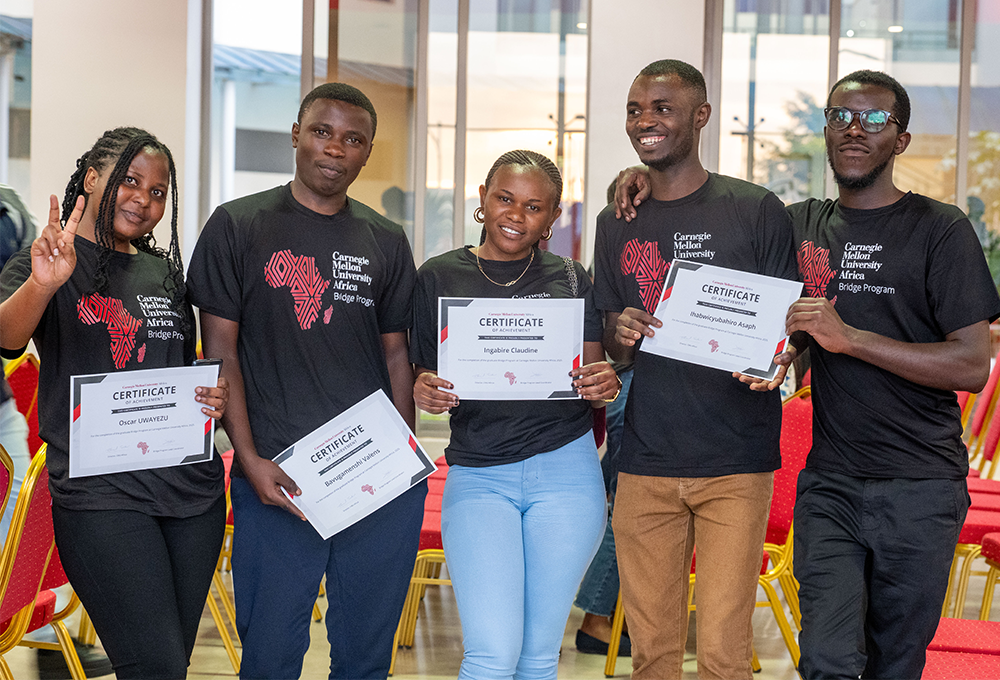
A group of students celebrate at their bridge program graduation at CMU-Africa.
"Students will gain technical expertise and also develop soft skills like communication, confidence, preparing applications, and interacting professionally. We are focusing on the skills that go beyond the classroom, for instance, how to engage with potential employers, negotiate contracts, and navigate the professional world," Conrad Tucker told the New Times at the recent program launch event.
He went on to say to the New Times, "Our goal is to use AI to boost learning and, at the same time, give students the technical skills to work with these technologies. We want them to be creators, not just consumers, applying these tools to solve problems in Rwanda, across Africa, and globally."
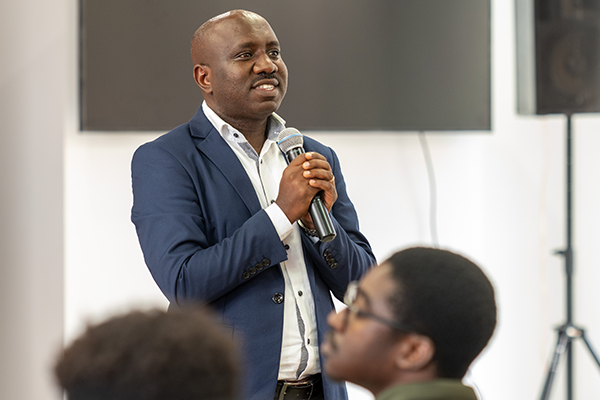
Emmanuel Ndashimye speaks at a bridge program graduation at CMU-Africa.
The program is an expansion of a CMU-Africa initiative which has provided skill building to undergraduate students for four years through support from the African Engineering and Technology Network. This new partnership with the University of Rwanda will greatly increase the impact of the program by allowing many more students to participate — almost ten times the current number of bridge program participants.
"We have seen that this type of bridge programming can address a skills gap among young engineers. So, we are excited to partner with the University of Rwanda to reach more students and prepare them for their future technology careers," said Emmanuel Ndashimye, assistant teaching professor and CMU-Africa bridge program lead.