Chisom Ogbogu optimizes use of off grid energy in new research
Patricia Raffaele
May 8, 2026
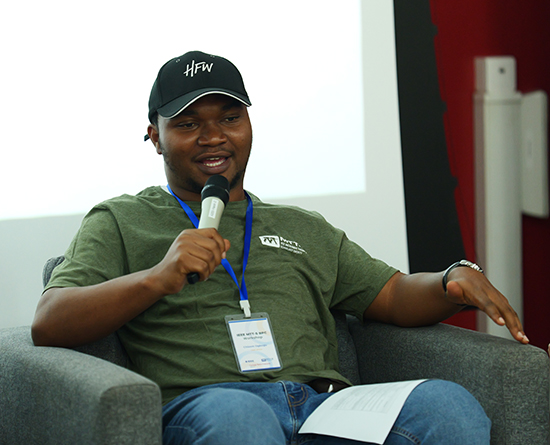
Chisom Ogbogu (MS ECE-AD '26) is seeking and developing energy solutions for Nigeria, Rwanda, and beyond. He draws motivation from his experience growing up with an uneven and unreliable energy supply in Lagos, Nigeria. Working with CMU-Africa assistant teaching professor Jesse Thornburg, Ogbogu is demonstrating a potential solution for reliable and cost-effective energy for Rwanda and sub-Saharan Africa.
"Nigeria and Rwanda continue to have the same issues with energy today that they had when I was growing up in Lagos. Like other areas across the continent, we don't have enough power for people and enough distribution networks to transmit and deliver the power," explained Chisom.
Ogbogu and Thornburg applied an AI-based model, particle swarm optimisation (PSO), to design a hybrid renewable energy system in Gisenyi, Rwanda, comprised of solar photovoltaic (PV), proton exchange membrane (PEM) electrolysers, hydrogen fuel cells, and battery storage.
The results show that the AI-based framework produced an optimal daily energy dispatch, with solar power dominating during the day and wind power contributing in the mornings and evenings. Notably, one result was a 69 percent reduction in the levelized cost of energy during peak solar hours.
"The results are exciting because the research demonstrates that Rwanda can achieve significant cost savings and higher reliability by combining renewable energy with storage under its least-cost energy development plan," he said. "The AI-driven optimization model is a scalable framework for Rwanda's energy transition and offers a pathway that can be useful across sub-Saharan Africa."
The research resulted in a published paper Particle Swarm Optimization for Dispatch Scheduling of Renewable Energy in Rwanda, and a presentation by Ogbogu and Thornburg at the 2025 IEEE PES/IAS PowerAfrica Conference in Cairo, Egypt.

Using a Power Swarm Optimization framework for energy, this graph depicts the reliable use of renewable energy in the town of Gisenyi, Rwanda. Solar use dominated during the day, wind use in mornings and evenings, and power came from the national grid when other sources were not available.
One of the driving factors for the research project is Rwanda's goal of installing grid-scale renewable energy by 2050 and addressing issues of uneven and unreliable power in the country. Ogbogu explained that their research applied an AI-based optimization process to link power sources, so the sources work when available, and use the national energy grid as backup.
"Our framework showed that once we connect the energy sources, we see a lower cost, and consistent energy delivery," he said, "The national grid backs up and stabilizes the system, so we don’t have to be running at full capacity off of the grid."
Ogbogu is now investigating the potential role of nuclear power, specifically small modular reactors, as another reliable energy option. He is exploring this option with potential partners and stakeholders.
In the meantime, he is applying to Ph.D. programs with an eye toward developing energy systems for Africa. He is also interested in energy security, especially in the United States and Europe.
"I love CMU, and I am a proud Tartan; I am grateful for the opportunity CMU gave me. It has been a great privilege to work with professors Jesse Thornburg, Barry Rawn, Sarath Tennakoon, and Ismaila Dabo. I also appreciate how special CMU-Africa is, because here I have colleagues who work together to share ideas and solve issues that all of us experience regularly," he said.