Financial inclusion and acknowledging the reality of ID sharing
Rachana Senthil
May 21, 2026
Edith Luhanga, assistant research professor at Carnegie Mellon University Africa, is working with colleagues to address a critical blind spot in how the world measures financial success. While global databases often equate financial inclusion with having a banking or mobile money (MoMo) account, Luhanga’s research suggests that the reality on the ground in sub-Saharan Africa is far more complex.
The study, “My Money, Your Name: Challenges and Workarounds in ID-Required Mobile Money in East Africa,” originally stemmed from a conversation around financial inclusion and how it is measured. The research was recently presented at the 2026 Association for Computing Machinery Conference on Human Factors in Computing Systems (ACM CHI). Through interviews with 72 urban and rural residents in Kenya and Tanzania, this study provides the first in-depth assessment of how third-party SIM cards are acquired and the challenges and workarounds that arise when using them for MoMo.
The research paper included co-authors Karen Sowon (Indiana University), Lorrie Cranor (Carnegie Mellon University), Giulia Fanti (Carnegie Mellon University), Conrad Tucker (Carnegie Mellon University), and Assane Gueye (Carnegie Mellon University, at the time of the research).
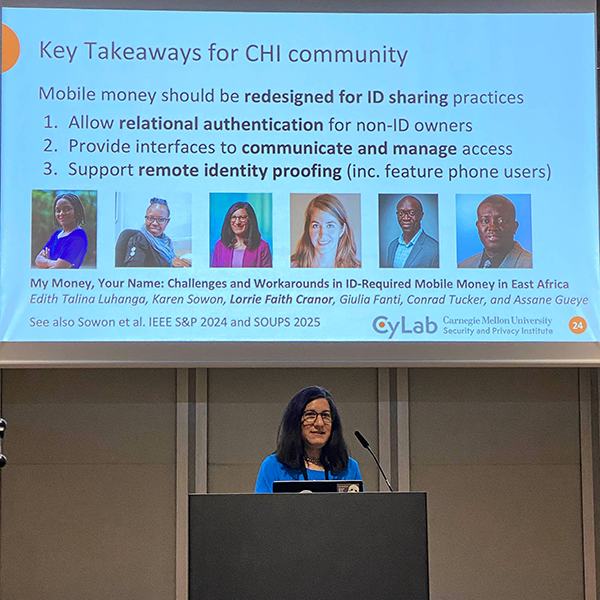
The research was recently presented at the 2026 Association for Computing Machinery Conference on Human Factors in Computing Systems (ACM CHI).
"At the time of our research, most sources like the global index database would define financial inclusion as access to a banking account," Luhanga explained. "But living in Africa, I knew, because I'd observed it, that not everybody is able to access these mobile money accounts in their own name, because they don't have an ID." This led her to question whether these users truly receive the benefits of savings and credit if they are transacting under a third party’s identity.
The motivation for the study was to move beyond surface level data and look at the qualitative drivers behind this behavior. Luhanga found that the desire for anonymity plays a significant role, particularly for business people or those avoiding digital harassment from creditors.
Systemic barriers also disproportionately affect specific demographics, particularly women and rural populations. Because the cost of a personal handset can be prohibitive, sharing devices or SIM cards becomes a necessity. Luhanga also points to the high failure rate of initial ID registrations, caused by both client-side errors and provider-side limitations. Additionally, the lack of registration centers in rural areas creates a significant burden.
"In Tanzania, what the government had been doing was coming up with pop-up centers to ease the burden of having to travel to urban areas. But that means you have to be available for that limited period. It's not always easy for things to go quickly,” she said.
A core argument of Luhanga’s paper is that security protocols must evolve to acknowledge the reality of ID sharing rather than simply trying to regulate it away. She highlights how personal relationships with agents often allow users to bypass formal regulations.
"We can start looking at creating systems that look at collaboration in mobile money as opposed to assuming it's just kind of like how you transact with an ATM," she suggested. "There's a level of personal relationship." This is vital because the current system can leave users vulnerable. "If that person whose ID I was registered under had done something, I'm implicated. We need to find a way to make sure everybody is identifiable,” she said.
My hope is that we can improve upon the reforms we are already seeing and advocate for more change.
Edith Luhanga, Assistant Research Professor, CMU-Africa
For Luhanga and her co-authors, this research is deeply personal. "For me and definitely for the other co-author who's from Kenya, Karen Sowon, this study was personal. We have experienced some of these challenges ourselves," she revealed, sharing that she temporarily resorted to using a third-party SIM card herself when her own ID expired. By bringing these lived experiences and data to the ACM CHI conference, Luhanga hopes to advocate for more equitable and secure digital financial systems.
The Global Findex 2025, released by the World Bank, now includes a measurement of people with accounts and those who have accounts under a third-party ID.
"The fact that our study highlights not just the ID sharing problem but also how the ID system itself contributes to this challenge are important contributions," she said. "My hope is that we can improve upon the reforms we are already seeing and hopefully advocate for more change."