The African startup fueling easier transport for farmers
Allen Warren
Jun 23, 2026
While Emmanuel Tuyizere was working in western Rwanda in 2023, his vehicle ran out of fuel. To get gasoline in such a rural part of the country, Tuyizere had to run to a neighboring district—a round-trip distance of over 30 kilometers (18.6 miles).
Tuyizere began reflecting on how farmers in the region fuel their own vehicles when stations are so few and far between. “I found that it’s really a high challenge for them to get the fuel,” he said. “From there I started to think, ‘Is there anything I can do that can support the people in that region to transport their cargo stuff from one place to another, but with their current infrastructure?’ ”
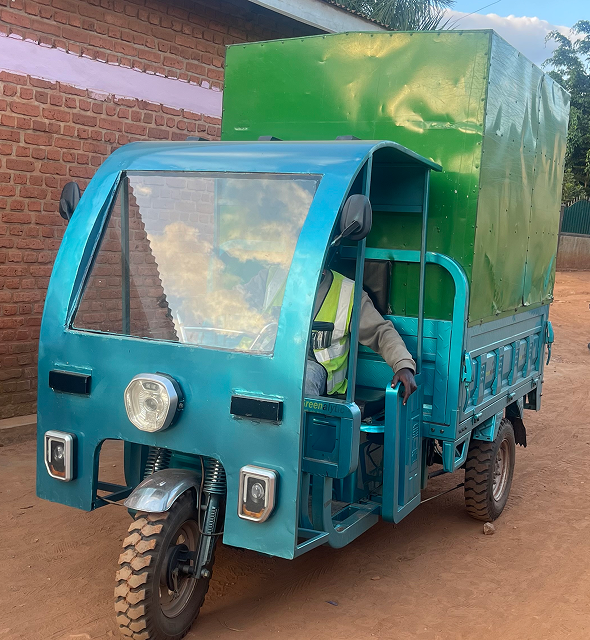
A Greenalytic electric cargo tricycle with driver.
This experience inspired Tuyizere to launch Greenalytic Motors, which recently wrapped up a year of funding and mentorship through Carnegie Mellon University Africa’s Business Incubation Program.
Tuyizere has a background in mechanical engineering. Speaking from his company’s workshop, he connected that background to the creation of Greenalytic’s two main products: an electric tricycle and a vehicle emissions monitor.
Greenalytic’s tricycles are aimed at rural smallholder farmers looking to bring their harvests to market, and these vehicles are built for tricky trips. Tuyizere noted how Rwandan farmers often face difficulties transporting their agricultural outputs: the lack of ready fuel; limited road infrastructure; and the hills, mountains, and other rugged terrain that define the country’s landscape. These challenges then raise the costs of food items able to reach markets.
The motorized tricycles address these challenges by relying on Rwanda’s abundant access to electricity and by being designed to withstand the wear and tear of off-road terrain. They produce zero emissions and require little upkeep. They also can hold several people and, most importantly, they can carry farmers’ valuable cargo.
Two models of tricycles exist for different transport needs. One model is equipped with a refrigerator able to keep fresh produce and meat as cool as -20 degrees Celsius (-4 degrees Fahrenheit). Another model is equipped with a milk tank. Many farmers struggle to transport fresh milk from their farms to collection centers, with milk many times spoiling or becoming contaminated during transport. This tricycle’s tank helps milk stay fresh and clean.
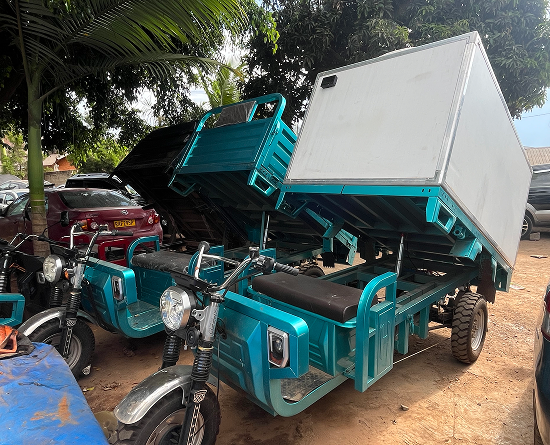
Greenalytic electric tricycles with cargo bays lifted.
The company’s second major product, an emissions monitor, also responds to the realities of Rwanda’s current infrastructure. In Rwanda and other developing countries throughout Africa, most vehicles being driven are older used models, which emit toxic fumes at higher-than-safe levels. The monitor is an in-vehicle device that can track these emissions and even help drivers diagnose what is causing their high emissions. It also provides real-time fuel consumption statistics. Together, this information can help drivers both be more environmentally friendly and cost effective while using their current vehicles.
The Business Incubation Program’s impact
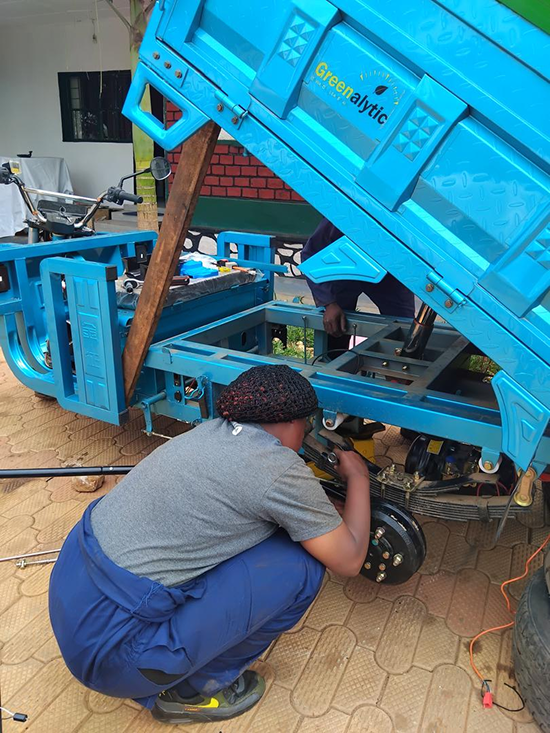
A worker tinkering on a Greenalytic electric tricycle.
Tuyizere explained that a number of early business limitations led him to apply to CMU-Africa’s Business Incubation Program. These hurdles included defining Greenalytic’s products to fit the market’s needs and then getting these products in front of customers.
“We were mainly focusing on product development and perfecting the program, but we were still struggling just to move from ideation to the product to securing the first paying customers,” he said. He went on to say, “We were not really a business.”
Tuyizere was drawn to the program for its access to business managers, whom he described as experienced mentors. These managers “know the current challenges a founder faces and have been advising us in different aspects so that we have managed to escape some of the challenges we would likely face along the way,” he said.
He also praised the program’s milestone-based approach. The company was required to set quarter-based goals before signing the Business Incubation Program contract, which he said helped the company’s performance: “The structure encouraged us to focus on measurable impact, customer acquisition, and sales and revenue generation, rather than only focusing on product development.”
For Tuyizere, the program’s stipends also helped in allowing him to focus on developing his business. He said the stipends, which cover monthly expenses like food and rent, gave him “an opportunity to work full time on the products and the company. Every allowance, they cover it so that the founders are only focusing on their businesses, their companies.”
The structure (of the program) encouraged us to focus on measurable impact, customer acquisition, and sales and revenue generation.
Emmanuel Tuyizere, Founder and CEO, Greenalytic Motors
Reflecting on his time with the Business Incubation Program, Tuyizere said the company has achieved significant improvements. For one, Greenalytic has seen a six-fold increase in revenue during its tenure in the program. It also has gone from three employees to more than 15. These additional team members signal “we have transitioned from being a product-focused to a customer-driven company,” he said.
Today, Greenalytic is better structured and touts more customers, employees, and market-ready products because it participated in the Business Incubation Program, Tuyizere said. Looking forward, he said the company’s main goals are to secure enough product output to supply the local market, but also to expand over the next two years into east Africa.