Practicum project focuses on helping support displaced entrepreneurs
Patricia Raffaele
Sep 23, 2026
A team of Carnegie Mellon University Africa (CMU-Africa) students spent last semester helping Inkomoko shift their client services from a manual system to a data-driven approach for a practicum project entitled, "AI-Driven Impact Measurement & Early Warning System for Refugee-Led Microenterprises." Inkomoko provides affordable loans and support to forcibly displaced entrepreneurs and host communities on the margin of financial systems in Rwanda, Ethiopia, Chad, and South Sudan
The team of students, who each graduated with a masters degree in engineering artificial intelligence, includes Giramata Muhoraceyeye, Matia Mukasa, Violette Uwamungu, and Samuel Wanza. Each student ranked Inkomoko as their first choice for their practicum.
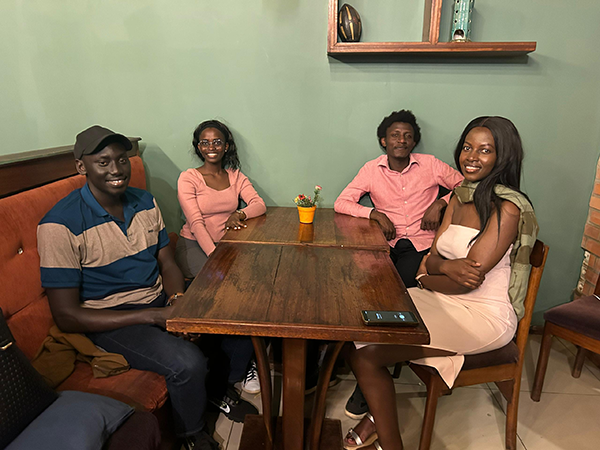
Source: Samuel Wanza
CMU-Africa students (now alumni), Matia Mukasa, Violette Uwamugu, Samuel Wanza, and Giramata Muhoraceyeye, helped Inkomoko shift their client services from a manual system to a data-driven approach on their practicum, allowing the company to provide timely support to their clients, refugee-led enterprises.
“After seeing the broad spectrum of the project and how they serve marginalized refugees, I chose Inkomoko,” Wanza said.
Practicums and capstone projects provide CMU-Africa students with the opportunity to find solutions to complex tech challenges presented by companies and organizations with support from the faculty. The students complete their specific projects within one semester. Businesses and organizations submit capstone project proposals which are evaluated by faculty before students rank their choices in order of their preference for specific projects.
“Our work was to help Inkomoko measure the impact of the companies they support through implementation of models based on factors such as job creation, revenue, and risk, with a short lead time,” Uwamungu said. Based on this model, Inkomoko can provide recommendations to clients in timely advisories, addressing potential risk earlier.

Source: Samuel Wanza
Capstone projects and practicums like the one completed last semester by a team of CMU-Africa students ,now alumni, help bridge the gap between academic learning and industry practice.
The team encountered challenges, including assigning risk levels to the funded organizations. After testing three alternative solutions, the team found that one solution performed significantly better than others.
“We also were challenged because, at first, we were working with synthetic data while building the solution,” Mukasa said. When the team had real data, they had to find a different method that was compatible with Inkomoko’s system.
The team also tested different models so Inkomoko could eliminate a survey provided to clients at the end of the project. Instead of a survey, the team recommended an AI model that shows how a business is performing in real time, and how the business could change based on different scenarios.
“We believe this will significantly improve the quality and the timelines of our advisory services and, in turn, our clients’ business outcomes. The students’ early warning system is exactly this capability. It identifies at-risk businesses early so our advisors can intervene proactively rather than reactively,” said Edwin Robert Bajje, IT project manager for Inkomoko.
After the May graduation ceremony, the team members are now reflecting on the capstone project experience and looking toward their future. Uwamungu, who is pursuing positions in AI and machine learning, said the capstone gave her the opportunity to “put into practice what she learned” while Mukusa, currently looking for job opportunities in AI, said the project “changed my focus from computer science to AI.” Wanza, who plans to pursue his Ph.D. in a few years, said the experience helped him “bridge the gap between academic learning and industry practice.”
By working with industry professionals alongside a team of peers, students have the opportunity to build more than just engineering skills. They note that they grew in their problem solving, creativity, confidence, and innovative thinking.
It’s been a great joy to graduate from CMU-Africa. Beyond technical skills, CMU-Africa helped me develop entrepreneurial thinking and essential soft skills.
Giramata Muhoraceyeye, alumna, CMU-Africa
“It’s been a great joy to graduate from CMU-Africa,” said Muhoracyeye, who is completing an apprenticeship and is applying for positions in data engineering. “Beyond technical skills, CMU-Africa helped me develop entrepreneurial thinking and essential soft skills.”